It Started with Wordle
Like millions of other people, I got hooked on Wordle in early 2023. There was something genius about its simplicity: one puzzle a day, six guesses, and a shareable emoji grid that took over group chats. I loved the daily ritual of it, and I kept thinking about what other domains could work with that same "guess and get feedback" loop.
Then one evening, while grocery shopping at Shufersal, I picked up a jar of Nutella and thought, "I genuinely have no idea how much this costs." I'd been living in Israel for a while, and despite shopping regularly, I couldn't tell you the price of most items within 10 shekels. That's when the lightbulb went off.
The Concept
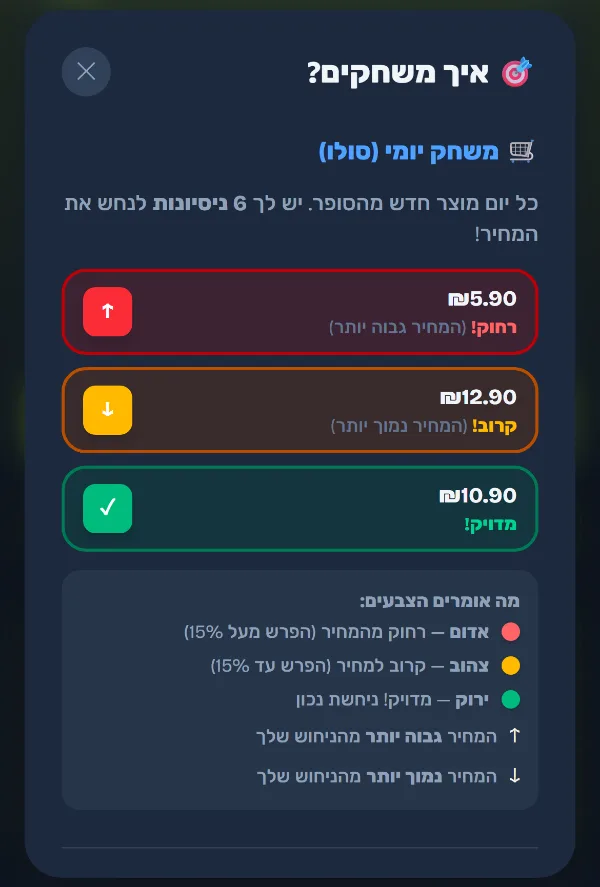
What if there was a daily game where you're shown a real product from an Israeli supermarket, and you have to guess its price? Not some made-up number, but the actual, current shelf price. You get 6 guesses, and after each one, the game tells you if you're too high, too low, or close enough.
I started sketching it out on paper that same night. The core loop was simple:
- Show the player a product image and name
- They type in their price guess
- Color-coded feedback: red means way off, yellow means getting warmer, green means nailed it
- 6 attempts to land within 15% of the actual price
- New product every day at midnight
Why This Felt Different
There are plenty of trivia games out there, but PriceGuess had something I hadn't seen before: it uses real, verifiable data. The prices aren't made up or historical. They're scraped from actual store listings, updated regularly. This means every guess is grounded in reality, and players actually learn something useful about the cost of living in Israel.
Living in Israel, price awareness is a real topic of conversation. People talk about the cost of cottage cheese, the price of hummus, whether avocados are in season. I wanted to turn that cultural awareness into something fun.
Initial Planning
Before writing any code, I mapped out what the MVP needed:
- A database of products with names, images, and current prices
- A daily selection mechanism (one product per day, same for everyone)
- A guess input with visual feedback
- Local storage to persist daily progress
- A share button for the classic emoji grid
I also made a few early decisions that shaped everything that followed. The interface would be in Hebrew, right-to-left, because this is an Israeli game for Israeli players. The design would be mobile-first, since most people would play on their phones. And I wanted it to feel polished, not like a side project thrown together over a weekend.
The Vision
Beyond the daily game, I had bigger ideas from day one. What if players could challenge each other in real-time 1v1 matches? What if there was a ranking system with leagues? What if there was a "picture mode" where you only see the product image, no name?
I wrote all of these down, knowing I'd tackle the MVP first and layer on features later. The daily game had to be solid before anything else mattered. But having that vision early helped me make architectural decisions that would support multiplayer down the line.
In the next post, I'll talk about the tech stack I chose and why Astro, React, and Cloudflare turned out to be the perfect combination for this kind of project.